How to Monitor Retail Stores Without Hiring a Nationwide Field Team
Getting your products into retail stores is a major milestone. Keeping track of what happens on those shelves is an ongoing job.
Products can run low, shelf labels can be incorrect, and promotional displays can look different from what your team expected. When your brand is carried across multiple markets, checking those details becomes harder.
Building a nationwide field team is one option, but it comes with recruiting, training, travel, scheduling, and management. For many CPG brands, a more practical approach is to use a distributed network of auditors to collect evidence in stores, supported by a consistent review and reporting process.
Here’s how to build that approach around the stores and questions that matter to your brand.
Start With the Questions You Need Answered
A useful store visit begins with a clear brief. “Check our retail presence” is too broad to produce consistent, actionable findings.
Instead, define what your team needs to verify.
Area to monitor | What to check |
|---|---|
Product availability | Are the expected products and variants visible on the shelf? |
Stock levels | Are there empty slots or visible gaps in the facing row? |
Shelf presentation | Are products upright, facing forward, and easy to identify? |
Placement | Are products in the expected section or display? |
Pricing | Does the shelf label match the product and expected price? |
Promotions | Is the expected promotional signage or display present? |
Packaging condition | Is there visible damage to products on the shelf? |
Give auditors the information needed to recognize your products: product images, names, sizes, variants, and SKUs where relevant. Include expected prices and promotional details when those checks are part of the visit.
The clearer the brief, the easier it is to compare findings across locations.
Choose Stores With a Specific Purpose
You don’t need to visit every location at the same frequency. Start with a group of stores that will answer a meaningful business question.
For example, a new retail launch may require confirmation that products have reached the shelf. An established account may need checks for recurring availability problems. A promotion may call for visits during the campaign window.
A practical monitoring plan can combine:
Priority stores: Locations that matter most to an upcoming launch, promotion, or retail relationship.
Rotating coverage: Different locations checked over time to broaden visibility.
Follow-up stores: Locations revisited after a problem is reported.
Use a confirmed list of locations expected to carry your products. A brand’s presence in a retail chain does not necessarily mean every store carries the same assortment.
That distinction also matters when reviewing findings: a product that is not carried at a location should be recorded separately from a product that is temporarily out of stock.
Use Local Auditors to Collect Consistent Evidence
A distributed audit network lets your team request store checks across different markets without hiring and managing employees in each region.
Local auditors visit assigned stores, photograph the relevant shelves, and record observations against your brief. Your internal team manages the scope and reviews the results.
Consistency is essential. Each visit should capture enough context to understand both the shelf section and any specific issue.
A useful evidence set includes:
A wider photo showing the relevant shelf section.
Clear images of the products and shelf labels.
Close-ups of any visible issues.
The store location and capture date.
Field notes where a photo needs additional explanation.
Keep main shelves and secondary displays separate in the report. A well-stocked endcap can coexist with an empty space in the main aisle, and combining them into one assessment can hide the problem.
Make Human Review Part of the Process
Collecting photos is only the first step. Someone still needs to check whether the evidence supports the reported finding.
An apparent gap might belong to another product. A price label may apply to a different size. A poorly framed image may not show enough of the shelf to establish whether a variant is missing.
AI can help organize and assess shelf images, but a review process should confirm findings before they reach your team.
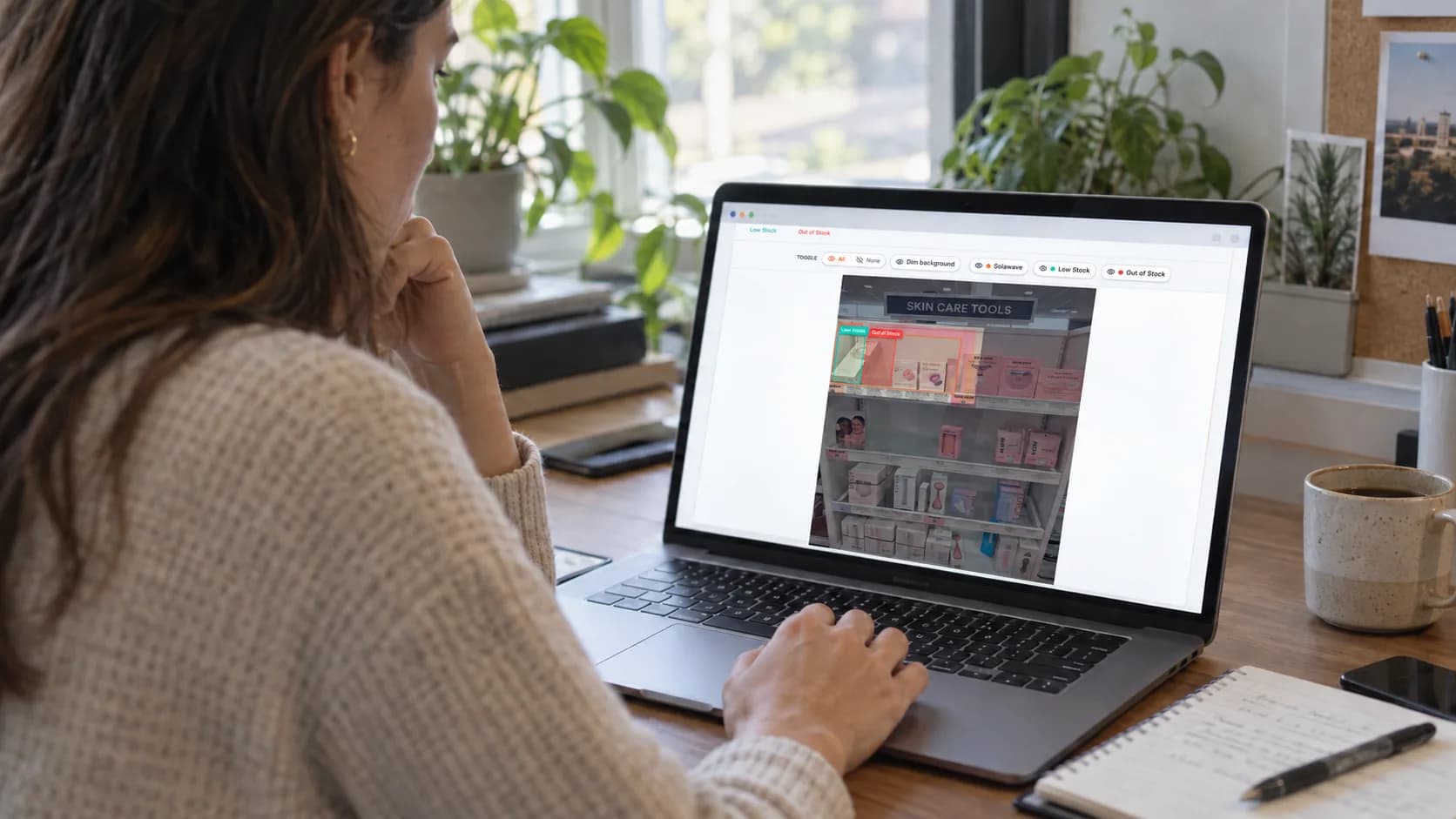
At PlanoIQ, field auditors photograph store shelves, AI assists with brand detection and shelf assessment, and a human reviewer confirms or corrects the findings before reports are published.
Reports include annotated photos and written assessments, giving your team evidence to review and share with retail partners.
A shelf photo also has limits. It shows what was visible at the time of the visit. It does not, by itself, establish backroom inventory, explain why a product is missing, or confirm that the condition continued after the auditor left.
Build a Monitoring Schedule Around Retail Activity
The right visit frequency depends on what is happening in the account.
Situation | Suggested monitoring approach | Main objective |
|---|---|---|
New retail launch | An initial check after expected shelf placement, followed by targeted revisits | Confirm products are present and correctly presented |
Ongoing distribution | Recurring checks across a rotating selection of locations | Track availability and presentation |
Active promotion | Visits while the promotion is running | Verify signage, pricing, and display execution |
Reported shelf issue | A follow-up visit after corrective action is expected | Check whether the visible issue has been resolved |
Upcoming buyer review | Recent checks across relevant stores | Bring current, documented observations to the discussion |
These are planning guidelines, not a fixed schedule for every brand. Adjust coverage based on what the reports reveal.
If a store repeatedly shows problems, it may deserve closer attention. If several checks are consistently clean, you may choose to shift some visits toward locations you have not yet reviewed.
Turn Findings Into Follow-Up Actions
A report is most useful when your team knows what to do with it.
Assign an internal owner to review findings and route them to the appropriate retail contact, account manager, or field partner. Include the store, affected product, observation, and supporting photo.
Finding | Practical next step |
|---|---|
Empty slot for an expected product | Share the evidence with the account or store contact to investigate availability |
Low visible stock | Flag the location for a replenishment discussion or follow-up check |
Incorrect shelf price | Compare the observed label with the expected price and request clarification |
Missing promotional signage | Share the photo with the team responsible for promotional execution |
Poor facing or misplaced products | Route the finding to the appropriate merchandising or retail partner |
An audit documents a condition. Physical correction is a separate task that needs a responsible owner.
For important issues, close the loop with another check rather than assuming that an email or service request means the shelf has changed.
Keep Results in One Place
As coverage grows, scattered photos and email threads become difficult to manage.
Use a reporting system that lets your team review findings by store, date, product, and issue type. This makes it easier to identify recurring problems and compare recent visits with earlier ones.
Useful measures include:
Which locations have been checked and how recently.
How often particular issues appear in audited locations.
Which stores show the same issue across multiple visits.
Whether follow-up checks show improvement.
Which locations still need coverage.
Always keep the scope visible. Findings from a selected group of stores describe those audited locations; they should not automatically be treated as a picture of the entire retail account.
Keep Your Team Focused on Decisions
You can build a repeatable store-monitoring process without hiring a nationwide field team. The essential pieces are a clear audit brief, relevant store coverage, reliable photo evidence, reviewed findings, and a defined follow-up process.
Your team stays responsible for account relationships and decisions. A distributed audit network handles the store visits and evidence collection.
PlanoIQ helps CPG brands put that process in place with store visits, annotated shelf photos, and human-reviewed reports covering availability, presentation, pricing, and promotional execution.
Start with 10 free store visits to see what’s happening at selected locations carrying your products. Create your PlanoIQ account.